
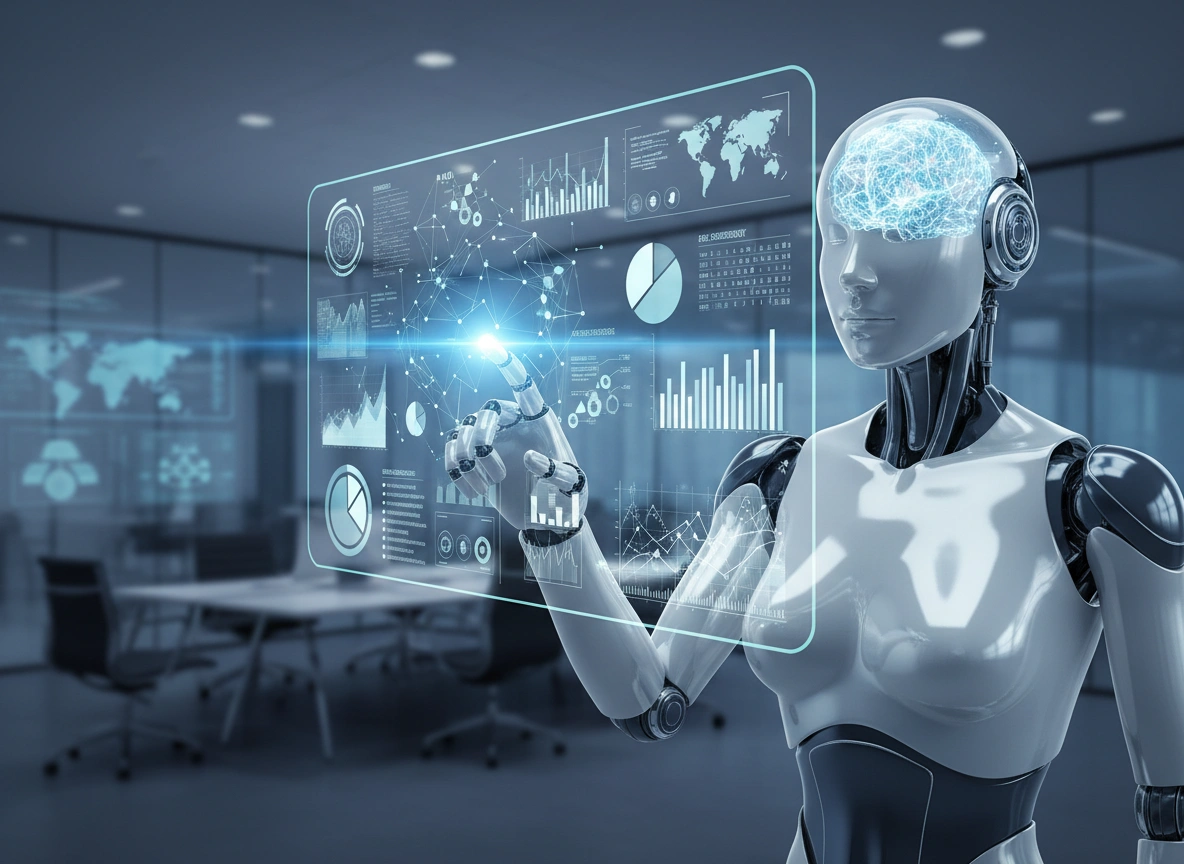
Every executive knows the feeling. You are staring at a quarterly report, a market analysis, and a budget spreadsheet, trying to synthesize hundreds of variables into a single strategic choice. For decades, this process relied heavily on gut instinct, experience, and basic data analysis. But the landscape has shifted. Artificial Intelligence (AI) has moved from the IT department’s sandbox to the boardroom table, fundamentally altering how organizations make choices.
This article explores the transformative role of AI in modern business decision-making. We will examine how intelligent algorithms process information, the tangible benefits they offer across industries, and the critical balance required between machine speed and human wisdom.
From Gut Feeling to Data-Driven Precision
Traditional decision-making often suffers from cognitive biases. Leaders might overvalue recent events (recency bias) or stick to failing strategies because they have already invested in them (sunk cost fallacy). AI does not suffer from these human limitations. It processes vast datasets impartially, identifying patterns invisible to the naked eye.
The primary shift is from reactive to predictive. Instead of looking at last month’s sales to guess next month’s inventory, AI models analyze historical trends, weather patterns, economic indicators, and social media sentiment to forecast demand with startling accuracy. This transition empowers businesses to act on what is likely to happen, rather than reacting to what has already happened.
Key Applications Across Industries
AI is not a one-size-fits-all solution; its application varies significantly depending on the sector. Let’s look at how specific industries leverage these tools to sharpen their strategic edge.
Finance: Managing Risk and Fraud
In the financial sector, milliseconds matter. Algorithmic trading uses AI to execute trades at speeds impossible for humans, capitalizing on fleeting market inefficiencies. However, the more profound impact is in risk assessment.
Banks now use machine learning models to evaluate loan applications. Instead of relying solely on a credit score, these systems analyze thousands of data points—transaction history, spending habits, and even employment stability—to create a nuanced risk profile. This reduces defaults while expanding access to credit for underserved populations who might lack traditional credit histories.
Additionally, AI is the first line of defense against fraud. Systems monitor millions of transactions in real-time, flagging anomalies that deviate from a user’s typical behavior. If you have ever received a text message asking if you just bought gas in a different state, you have interacted with AI decision-making.
Healthcare: Life-Saving Diagnostics
Healthcare executives and practitioners use AI to make critical decisions regarding patient care and resource allocation. IBM Watson Health and similar platforms analyze medical literature, patient records, and clinical trial data to suggest potential treatment paths.
For hospital administrators, AI predicts patient inflow. By analyzing seasonal illness trends and local event schedules, hospitals can decide how many nurses to staff in the ER on a Friday night, ensuring resources are available when needed most without unnecessary overhead.
Retail: Personalization at Scale
Retailers face the constant decision of what to stock and who to target. AI answers both. Recommendation engines, like those used by Amazon or Netflix, decide which products to show a user based on their browsing history. This isn’t just a convenience; it’s a strategic decision to maximize conversion rates.
Supply chain decisions are also heavily automated. AI tools predict inventory needs for specific store locations. If a heatwave is predicted, the system might automatically order more air conditioners and sunscreen for stores in the affected region, preventing stockouts and capitalizing on demand.
Manufacturing: Predictive Maintenance
In manufacturing, equipment failure is costly. The decision of when to service a machine used to be based on rigid schedules. Now, utilizing the Internet of Things (IoT), sensors feed data into AI models that predict exactly when a part is likely to fail.
This allows plant managers to decide to perform maintenance during scheduled downtime rather than reacting to a catastrophic breakdown during a production run. This shift from “break-fix” to “predictive maintenance” saves millions in lost productivity.
The Benefits of AI-Enhanced Decision Making
Implementing AI isn’t just about keeping up with trends; it offers concrete operational advantages.
Speed and Efficiency
Humans fatigue; algorithms do not. AI can process data 24/7, accelerating the decision-making cycle. In logistics, for instance, AI can re-route an entire fleet of delivery trucks in seconds based on real-time traffic accidents and weather conditions—a task that would take human dispatchers hours.
Removing Subjectivity
While human intuition is valuable, it is often clouded by emotion or office politics. An AI algorithm doesn’t care whose idea it was to launch a product; it only cares about the data indicating market viability. This objectivity helps organizations kill failing projects faster and double down on winners with confidence.
Uncovering Hidden Opportunities
Big data is often too “big” for humans to comprehend. AI excels at finding non-obvious correlations. A retail chain might discover through AI analysis that sales of a specific snack food correlate with the release of a certain genre of video game, allowing for a cross-promotional marketing decision that no human marketer would have conceived.
The Challenges: Data, Ethics, and The Black Box
Despite the benefits, the road to AI integration is paved with challenges that leaders must navigate carefully.
The Data Quality Dilemma
AI is only as good as the data it is fed. If a business feeds its algorithms “dirty data”—incomplete, outdated, or inaccurate information—the resulting decisions will be flawed. This is often summarized as “Garbage In, Garbage Out.” Companies must invest heavily in data governance and hygiene before they can rely on AI for high-level strategy.
The “Black Box” Problem
Many advanced deep learning models are opaque. They provide an answer, but they cannot explain how they arrived at it. In high-stakes industries like law or healthcare, a “black box” decision is risky. If an AI denies a loan or suggests a surgery, stakeholders need to understand the “why.” This has led to a push for “Explainable AI” (XAI), which aims to make the decision-making process transparent.
Ethical Considerations and Bias
AI can inherit the biases of its creators or the historical data it trains on. If a hiring algorithm is trained on ten years of resumes from a male-dominated industry, it may “learn” to penalize resumes from women. Leaders must be vigilant in auditing their AI tools for bias to ensure fair and ethical decision-making.
The Future: Augmented Intelligence
The narrative often pits humans against machines, asking when AI will replace the CEO. This is a false dichotomy. The future of business decision-making lies not in replacement, but in augmentation.
The most successful companies view AI as a force multiplier for human intelligence. AI handles the heavy lifting of data processing, probability analysis, and pattern recognition. This frees up human leaders to focus on what machines cannot do: empathy, ethical judgment, creative strategy, and managing complex stakeholder relationships.
We are moving toward a hybrid model where AI acts as the ultimate advisor. It presents the options, the probabilities of success, and the potential risks. The human leader then applies context—corporate values, brand reputation, and long-term vision—to make the final call.
Conclusion
The role of AI in business decision-making is no longer theoretical; it is foundational. From predicting supply chain disruptions to personalizing customer experiences, AI provides the clarity and speed required to compete in a digital economy.
However, technology is a tool, not a strategy. The businesses that thrive will be those that recognize the limitations of AI as clearly as they recognize its power. They will invest in clean data, prioritize ethical algorithms, and foster a culture where human insight and machine precision work in concert. As we look to the future, the best decisions will not be made by man or machine alone, but by the powerful synthesis of both.
Please visit website for more info
