

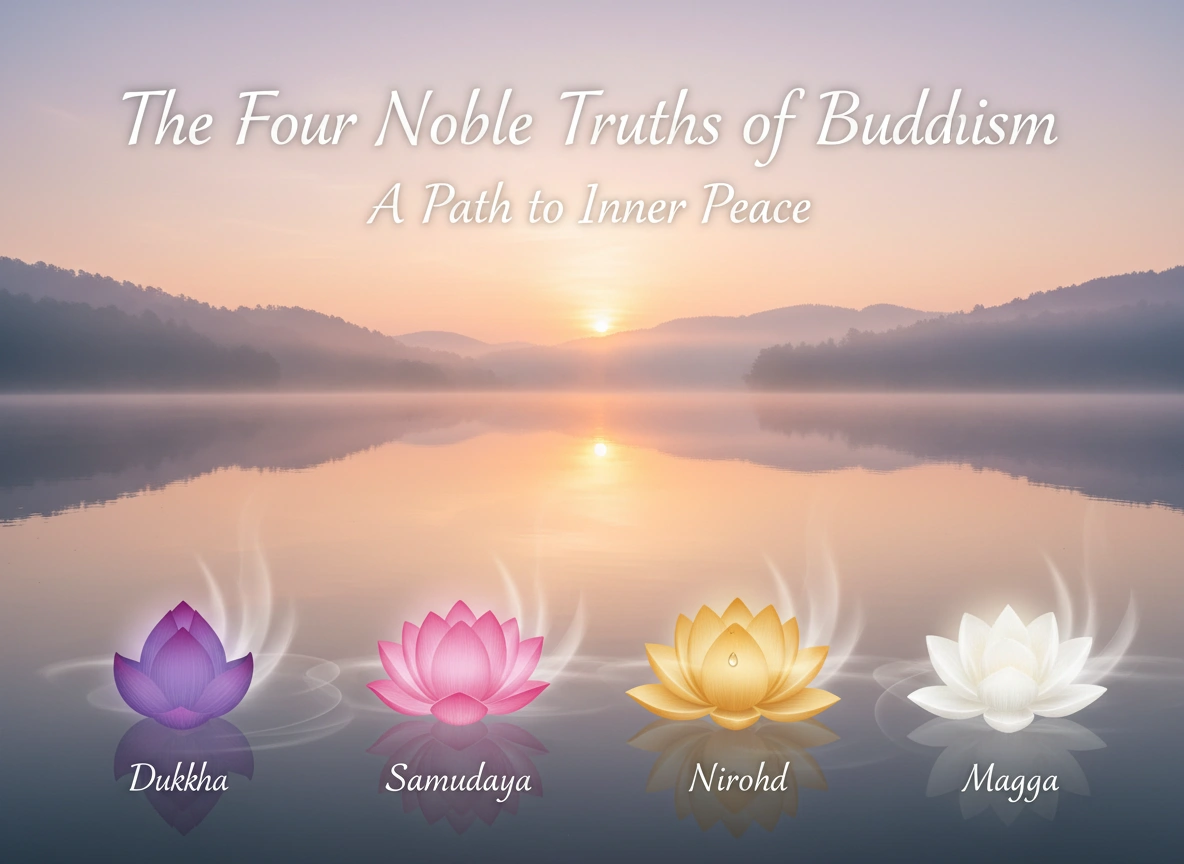
The quest for lasting happiness and inner peace is a timeless and universal human endeavor. Across cultures and throughout history, individuals have sought methods to alleviate suffering and find a stable sense of well-being amidst life’s inevitable challenges. Within the rich tapestry of spiritual and philosophical traditions, Buddhism offers a uniquely pragmatic and profound framework for this journey. At the very heart of its teachings lie the Four Noble Truths, the foundational sermon delivered by Siddhartha Gautama, the Buddha, shortly after his enlightenment over 2,500 years ago. These truths are not presented as articles of faith to be blindly accepted but as a direct, observational diagnosis of the human condition and a practical prescription for its remedy. They offer a clear and structured path from suffering to liberation, guiding individuals toward a state of genuine inner peace.
The Historical Context of the Four Noble Truths
To fully appreciate the significance of the Four Noble Truths, it is important to understand their origin. Siddhartha Gautama was a prince who lived a life of immense luxury, shielded from all forms of hardship. However, his encounters with an old man, a sick man, a corpse, and a wandering ascetic—known as the Four Sights—awakened him to the unavoidable realities of aging, illness, death, and suffering. This profound realization compelled him to renounce his privileged life and embark on a spiritual quest to find the end of suffering.
After years of extreme asceticism and deep meditation, he achieved enlightenment while sitting under the Bodhi tree. His first teaching, delivered to his five former companions in the Deer Park at Sarnath, India, was the discourse on the Four Noble Truths. This event, known as “setting in motion the wheel of the Dharma,” established the core principles upon which the entirety of Buddhist philosophy and practice is built. The truths are framed in the classical medical model of the time: identifying the illness, diagnosing its cause, determining if a cure is possible, and prescribing the treatment. This approach underscores the practical, problem-solving nature of the Buddha’s teachings.
Unpacking the Four Noble Truths
The Four Noble Truths provide a logical progression of thought that moves from identifying a problem to implementing its solution. They are interconnected and must be understood as a cohesive whole.
The First Noble Truth: The Truth of Suffering (Dukkha)
The first truth states that life is characterized by suffering, or dukkha. This is perhaps the most misunderstood of the four truths. It is not a pessimistic declaration that life is only pain and misery. Instead, it is a realistic observation of the human experience. The Buddha identified several forms of dukkha:
- The Suffering of Pain: This includes the obvious forms of physical and mental pain, such as illness, injury, grief, loss, and the stress of daily life.
- The Suffering of Change: This refers to the anxiety and dissatisfaction that arise from the impermanent nature of all things. Even pleasant experiences are a source of subtle suffering because they are fleeting. The happiness derived from a promotion, a new relationship, or a delicious meal eventually fades, leaving a sense of longing or disappointment.
- The Suffering of Conditioned Existence: This is the most profound level of dukkha. It points to the fundamental unsatisfactoriness of our ordinary, conditioned existence—a state driven by ignorance and a constant cycle of craving and aversion. It is the background hum of unease that persists even when things are going well, stemming from our deep-seated attachment to a self that is, in reality, constantly in flux.
Recognizing this truth is not about becoming despondent; it is about honestly acknowledging the nature of our experience. It is the necessary first step toward finding a lasting solution.
The Second Noble Truth: The Truth of the Origin of Suffering (Samudāya)
Having identified the illness, the Buddha proceeds to diagnose its cause. The second truth asserts that the origin of suffering is craving, desire, and attachment, referred to as tanhā (literally “thirst”). This craving manifests in three primary ways:
- Craving for Sense Pleasures: The desire for pleasant sights, sounds, smells, tastes, and physical sensations. This leads to a relentless pursuit of external gratification that can never be permanently satisfied.
- Craving for Existence: The deep-seated desire to continue to exist, to become something more, and to perpetuate our sense of self. This fuels ambition, pride, and the fear of annihilation.
- Craving for Non-Existence: The desire to get rid of something unpleasant, such as pain, a difficult situation, or even life itself. This is the root of aversion, hatred, and self-destructive impulses.
It is this constant thirst—this pushing and pulling against reality—that creates the friction and dissatisfaction we experience as suffering. Our attachment to things being a certain way, and our resistance when they are not, is the engine of our own discontent.
The Third Noble Truth: The Truth of the Cessation of Suffering (Nirodha)
The third truth offers a message of profound hope: the cessation of suffering is possible. If suffering arises from a cause—craving and attachment—then it can be eliminated by removing that cause. This state of cessation is known as Nirvana, a state of complete liberation, profound peace, and the end of all suffering.
Nirvana is not a heavenly paradise but a state of mind that can be realized in this very life. It is the extinguishing of the “fires” of greed, hatred, and delusion. When craving ceases, the mind is no longer pulled in different directions by desire and aversion. It becomes calm, clear, and stable. This is the ultimate inner peace—a state of being that is unshakeable, regardless of external circumstances. The third truth confirms that a cure for our fundamental unease exists and is attainable.
The Fourth Noble Truth: The Truth of the Path to the Cessation of Suffering (Magga)
Finally, the Buddha prescribes the treatment. The fourth truth lays out the practical method for achieving the cessation of suffering: the Noble Eightfold Path. This path is not a sequential set of steps but a collection of eight interconnected practices that should be developed simultaneously. It is often referred to as the “Middle Way” because it avoids the extremes of sensual indulgence and severe asceticism.
The Eightfold Path is grouped into three divisions of training:
- Wisdom (Prajñā):
-
- Right Understanding: Correctly understanding the Four Noble Truths and the nature of reality.
- Right Thought: Cultivating thoughts of loving-kindness, compassion, and non-harming, while abandoning thoughts of greed, hatred, and cruelty.
- Ethical Conduct (Sīla):
-
- Right Speech: Abstaining from lying, divisive speech, harsh speech, and idle chatter.
- Right Action: Behaving in ways that are non-violent and do not harm oneself or others.
- Right Livelihood: Engaging in a profession that does not cause harm to other beings.
- Mental Discipline (Samādhi):
-
- Right Effort: The persistent effort to prevent unwholesome states from arising and to cultivate wholesome states.
- Right Mindfulness: Developing clear awareness of one’s body, feelings, thoughts, and the phenomena of the world in the present moment.
- Right Concentration: Cultivating a focused, one-pointed state of mind through meditative practices, which allows for deep insight.
By cultivating these eight factors, an individual systematically purifies their mind, transforms their behavior, and develops the wisdom needed to uproot the causes of suffering.
A Practical Guide to Inner Peace
The Four Noble Truths and the Eightfold Path are not abstract philosophical concepts; they are a direct and practical guide for navigating life. The path begins with the simple, honest recognition of dissatisfaction in our lives. From there, we use mindfulness to observe our own minds and see how craving and aversion create our stress. We begin to understand that peace is not found by changing the world to fit our desires, but by changing our relationship to our own experience.
Practicing ethical conduct—speaking truthfully, acting kindly, and earning a living honorably—creates an external environment of peace and an internal sense of self-respect. This moral foundation allows the mind to settle. Through mental discipline and meditation, we learn to quiet the constant mental chatter and observe reality as it is, free from the distortions of our desires and fears. This clarity gives rise to wisdom, allowing us to see the impermanent and interconnected nature of all things, thereby loosening the grip of attachment.
In following this path, one gradually moves from a life of reactive suffering to one of conscious, peaceful existence. The Four Noble Truths provide the map, and the Eightfold Path provides the vehicle. The destination is not a distant shore but a quality of being—a profound and unshakable inner peace that is available to us in every moment.Please visit this website for more info.
You may also read: Air Pollution: How to Protect Yourself and the Environment
